Warehouse & Distribution Center Cleanouts Town 'N' Country
Warehouse & distribution center cleanouts in Town 'N' Country, Florida cover the removal of unwanted, nonhazardous contents from commercial storage and distribution properties—after facility access, material identification, and operational coordination are understood. Clean Cut Property Solutions reviews each warehouse cleanout against the actual materials on site, the loading arrangements, and the facility's operating schedule.
This is a contents-hauling scope, not industrial dismantling or inventory liquidation. Share the warehouse address, photos of the materials, an approximate inventory, the loading dock or staging setup, and the authorized contact so the project can be reviewed honestly against your operation rather than as a generic commercial pickup.
Warehouse Contents & Distribution Project Types
Warehouse cleanout covers the haul-off of suitable nonhazardous contents from commercial storage and distribution space. The categories below reflect common requests; whether a specific load can be collected depends on material acceptance, loading access, and operational coordination confirmed during review.
Warehouse Storage Contents
Empty pallets and palletized debris, nonhazardous packaging, cardboard and packing materials, unwanted storage furniture, commercial shelving contents, and approved miscellaneous stored materials accumulated in a warehouse or distribution space.
Distribution Center Debris
Office furniture located within warehouses, suitable bulky items, selected obsolete fixtures, and nonhazardous warehouse clutter generated by reorganization, repositioning, or a change in how the facility is used.
Commercial Facility Cleanout Projects
Distribution facility contents staged for collection during a reconfiguration, closure, lease transition, or consolidation—reviewed with attention to loading dock access, truck routing, and the facility's operating rhythm.
Warehouse cleanout inquiries commonly include empty pallets and palletized debris, nonhazardous packaging, cardboard and packing materials, unwanted storage furniture, commercial shelving contents, office furniture within warehouses, approved miscellaneous stored materials, nonhazardous warehouse clutter, suitable bulky items, selected obsolete fixtures, and distribution facility contents. Each category hauls differently depending on weight, volume, and how it is staged for loading.
It is important to distinguish contents hauling from the adjacent scopes this page does not cover. Equipment dismantling, industrial demolition, inventory liquidation, and hazardous-material handling are separate specialties. We focus on the haul-off of suitable nonhazardous contents; we do not represent that we perform certified inventory destruction, chemical removal, or industrial equipment dismantling without verified capability.
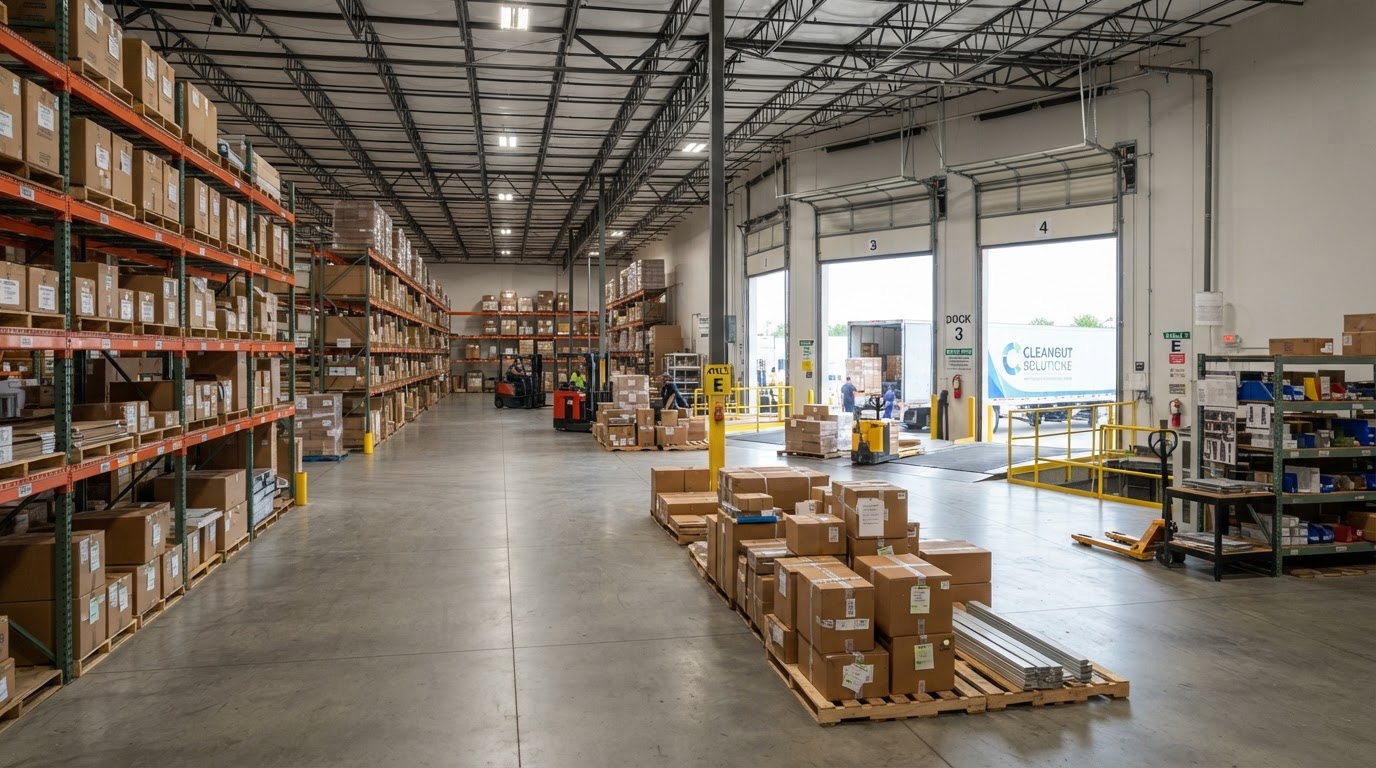
A warehouse cleanout also differs from a routine office cleanout in scale and access. Loading docks, truck routing, dock-height doors, forklift traffic, designated staging areas, and restricted zones all shape how materials can be collected without disrupting an active operation. Those conditions are reviewed as part of the project rather than assumed.
Facility Coordination & Project Planning
A warehouse cleanout follows a careful sequence: confirm the authorized facility representative, inventory the materials, review loading dock and truck access, and confirm the operational window before any hauling is scheduled.
Confirm Authorized Representative
Identify the facility manager or authorized contact who can approve the removal and coordinate access, loading areas, and any restricted zones within the warehouse.
Inventory Materials for Removal
List the material types and approximate quantities—pallets, packaging, shelving contents, obsolete fixtures. Photos of each staging area keep the inventory accurate.
Review Loading Dock & Truck Access
Describe the dock doors, dock height, trailer access, yard routing, and any restrictions on truck size or staging time. Access shapes how a load can be collected.
Flag Operational & Security Rules
Note operating schedules, forklift traffic, restricted zones, security procedures, and items excluded from removal so the project fits around an active facility.
Estimate Volume & Weight
Translate the inventory into an approximate load size and weight. Pallet counts, packaging volume, and mixed materials all influence how the load is planned.
Coordinate Timing & Handoff
Once materials, access, and operational rules are understood, the timing and handoff are coordinated with facility staff so hauling does not interrupt the operation.
We do not claim Clean Cut operates forklifts, industrial lifts, or heavy equipment without verified capability. Where palletized or heavy materials require mechanized handling to reach a loading point, that is identified during planning and coordinated with facility equipment rather than assumed as part of the hauling scope.
Coordination with facility staff is part of every warehouse project. An authorized representative confirms the items designated for removal, the loading area, and the operational window; photos and a quantity estimate keep the conversation grounded in what is actually on the floor rather than a generic warehouse-cleanup scope.
Preparation & Estimate Factors
Warehouse cleanout estimate factors reflect real material volume, weight, loading access, and coordination complexity—not a flat commercial rate. These factors shape the conversation about your project.
Warehouse square footage, the material quantities within it, and the weight and volume of those materials are the starting points. A bay of empty pallets hauls very differently from palletized obsolete fixtures or a mixed load of packaging, shelving contents, and office furniture. Pallet counts, storage location, and working height all influence how the load is staged and moved.
Facility restrictions round out the picture. Restricted zones, security procedures, operating schedules, and mixed materials all add coordination complexity, and equipment requirements—dock-level access, yard room for a trailer, or mechanized handling—can determine whether a load can be collected as planned.
Disposal limitations and coordination complexity close out the estimate. We do not advertise certified destruction, chemical removal, inventory liquidation, or industrial dismantling without verification. The estimate reflects the real materials, the real access, and the real operational constraints—not a fixed warehouse-cleanup price.
Warehouse & Distribution Center Cleanout FAQs
Direct answers about what warehouse contents can be hauled, palletized debris, active operations, loading access, and rack dismantling in Town 'N' Country.
Discuss a Warehouse Cleanout
Share the warehouse address, photos of the materials and staging areas, an approximate inventory with quantities, the loading dock or trailer arrangement, and the authorized facility contact so we can review the warehouse-cleanout scope honestly. Prefer to talk it through? Call 813-857-6752.