
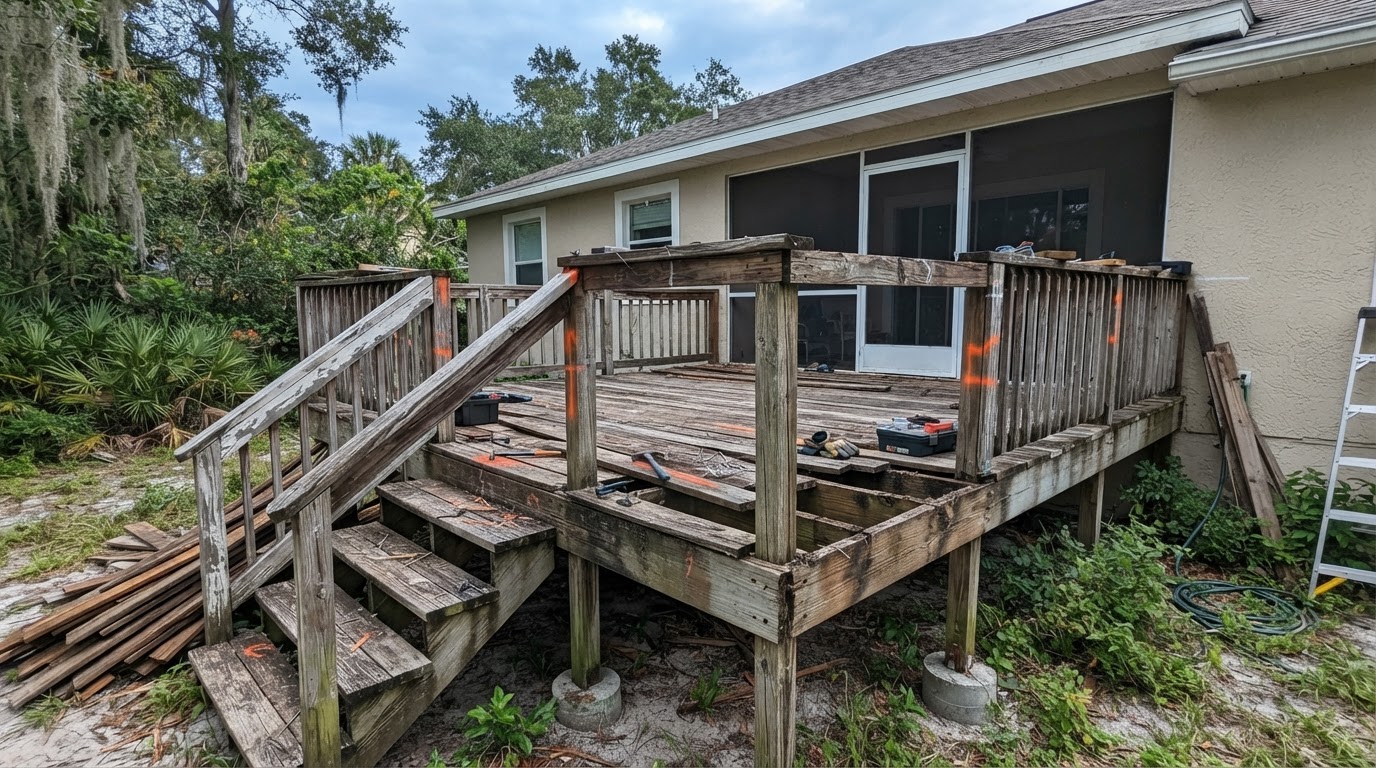
Deck Removal & Demolition Town 'N' Country
Deck removal and demolition in Town 'N' Country, Florida clears an old, damaged, or unwanted deck so the space is open for replacement, landscaping, or a new use. Clean Cut Property Solutions reviews deck demolition inquiries with attention to the deck's size, height, materials, how it attaches to the home, and the access a crew and trailer need to reach the backyard.
Describe the deck, its dimensions, and how it connects to the house, and we will talk through whether the removal fits our scope. We do not assume every deck is a simple ground-level tear-down or that footing removal and surface repairs are automatically included—each deck removal is reviewed on its own conditions.
Deck Removal Projects & Materials
Deck demolition covers the dismantling and haul-off of residential decks. The categories below reflect common removal requests; whether a specific deck can be removed depends on size, elevation, attachment, structural condition, and access confirmed during review.
Wood Deck Demolition
Pressure-treated wood decks, cedar, and other wood-framed decks are unbolted, cut apart, and hauled off. Surface boards, railings, stairs, and support framing each come out as the structure is dismantled.
Composite Deck Removal
Composite decking materials dismantle differently than wood—denser panels, hidden fasteners, and composite framing all affect the labor and debris plan. Material type drives how the deck comes apart.
Attached & Elevated Deck Considerations
Attached decks connect to the home through a ledger board, and elevated decks carry load through posts and footings. Both require additional assessment of the building envelope and structural supports.
Deck removal covers wood decks, composite decks, ground-level decks, elevated decks, freestanding decks, and attached decks. Each type comes apart differently, and the materials—pressure-treated lumber, composite boards, metal railings, and concrete footings—shape the debris volume and hauling plan. Deck railings, deck stairs, surface boards, and support framing are all part of the structure.
Elevated, attached, or load-bearing decks require additional assessment. A ground-level freestanding platform is a different project from an elevated deck attached to the home through a ledger board, and an attached deck's removal has implications for the building envelope and the exterior surfaces that remain. We do not treat every deck as the same job.
Deck removal is often preparation for new landscaping, a replacement structure, or property reconfiguration. We review the removal scope honestly without promising deck installation, surface repair, or replacement construction—those are separate from the demolition and haul-off we discuss.
Site Assessment & Removal Planning
A deck removal follows a careful sequence: document the deck's footprint and height, review materials and attachment, inspect structural supports and footings, confirm access, and plan the dismantling and debris haul-off. Photos and dimensions support an honest assessment.
Share Deck Footprint & Height
Provide the deck's approximate dimensions and how high it sits off the ground. Elevation changes the labor, equipment, and safety planning required for the removal.
Identify Materials
Note whether the deck is wood, composite, or mixed, plus the railing and stair materials. Material type drives how the deck comes apart and the debris volume.
Review Attachment to the Home
Describe how the deck connects to the house—ledger board, freestanding, or attached framing. Attachment affects the building envelope and what remains after removal.
Inspect Structural Supports
Note posts, footings, and support framing. Elevated or load-bearing structures require additional assessment before any dismantling is planned.
Confirm Backyard Access
Describe gate width, side-yard access, landscape obstacles, and nearby utilities. Trailer and crew access determines how debris is hauled out.
Plan Dismantling & Debris
We review the deck, attachment, and access together so the dismantling sequence and debris hauling plan reflect what is actually on site.
Removing an attached deck requires consideration of the remaining building envelope and exterior surfaces. A ledger board bolted to the house leaves fastener penetrations in the wall once removed, and the siding, flashing, or stucco behind the ledger may need attention from a qualified contractor after the deck comes down. We flag those considerations rather than treating attachment as incidental.
We do not guarantee foundation removal, wall repairs, or replacement deck installation. Footings set in concrete, posts, and support framing are reviewed as part of the removal scope, and any repairs to adjoining surfaces after removal are discussed as separate work rather than assumed included.
Preparation, Permits & Estimate Factors
Deck removal estimate factors reflect the deck's size, elevation, attachment, and condition—not a flat rate. These factors shape the conversation about your project.
Deck size and elevation are the starting points. A small ground-level platform and a large elevated deck attached to a second story produce very different labor, equipment, and safety plans. Attachment method—ledger to the house, freestanding, or tied into adjacent framing—changes what remains after removal and what repairs the building envelope may need.
Structural condition and material weight matter. A deteriorated deck with rotting boards may come apart more easily but can reveal footing or framing problems underneath. Fasteners, composite density, and the presence of hidden hardware all affect dismantling time. Footing removal—posts set in concrete below grade—is a separate consideration from the deck structure itself.
Backyard access, utility concerns, and permit requirements all influence the estimate. A narrow side gate, a deck over a finished basement, or footings near underground utilities each change the plan. We do not claim all decks are exempt from permitting; permit needs are confirmed against the actual project and the applicable jurisdiction. Possible repairs to adjoining surfaces after removal are discussed as separate work rather than assumed included.
Deck Removal & Demolition FAQs
Direct answers about deck demolition, materials, elevation, attachment, footings, and estimate factors in Town 'N' Country.
Discuss Deck Removal & Demolition
Share the deck's dimensions, approximate height, attachment photos, materials, and backyard access so we can review the removal scope honestly. Prefer to talk it through? Call 813-857-6752.